

Employees living with Rheumatoid Arthritis (RA) and Ankylosing Spondylitis (AS) often manage daily joint pain, stiffness, and reduced mobility while continuing to meet workplace responsibilities. These conditions can also affect focus, confidence, and emotional wellbeing, making everyday work more challenging.
With the right workplace support and flexible work environment, employees with RA and AS can stay productive, engaged, and motivated in their roles.
Organisations that support employees with RA and AS often benefit from:
RA and AS are invisible conditions. An employee may look healthy from the outside. Inside, they may be managing serious joint pain, morning stiffness, or exhaustion from a recent flare.
Many employees manage their symptoms quietly. They keep working without telling anyone. They fear being seen as less capable.
This is why inclusive workplace policies matter. A workplace that makes inclusion a priority does three things well:
It also shows a real commitment to supporting employees with chronic illness not just in words, but in practice.
Research shows that up to 60% of people with Rheumatoid Arthritis say their condition affects their ability to work yet many never disclose this to their employer out of fear of being treated differently.
Employees living with Rheumatoid Arthritis (RA) and Ankylosing Spondylitis (AS) often experience challenges in three key areas: physical health, workplace responsibilities, and emotional well being. Recognising and understanding these challenges is essential to providing the right support and creating a more inclusive work environment.
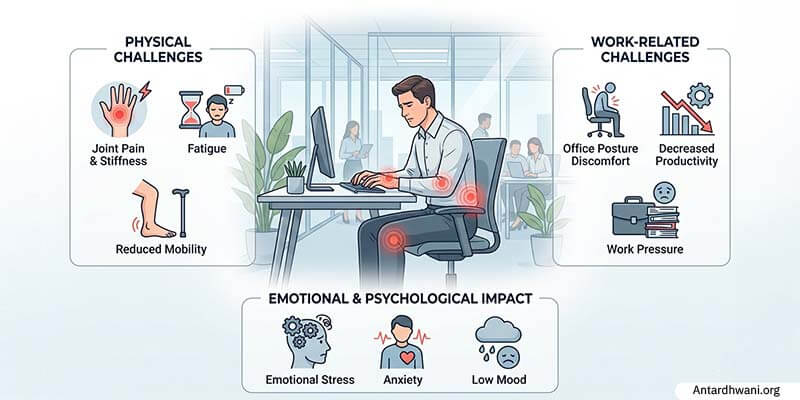
In some cases, Ankylosing spondylitis complications such as spinal stiffness and posture issues can further intensify these challenges over time.
Many people assume that supporting an employee with a chronic condition means lowering expectations, but it actually means removing unnecessary barriers so a capable person can perform their job effectively.
Here is what happens when the right support is in place:
When employees do not receive proper support, many continue working through constant pain until it becomes impossible to manage. This often leads to long periods of sick leave or even resignation, both of which can have a far greater impact on organisations than simple workplace adjustments such as flexible hours or ergonomic support.
A study in Rheumatology International found that workplace adjustments reduced absenteeism by up to 30% in employees with inflammatory arthritis and meaningfully improved their self-reported productivity.
Good support does not require a large budget. Most effective workplace adjustments are low cost or completely free. What matters most is awareness, understanding, and a willingness to be flexible. Increasing Rheumatoid Arthritis and Ankylosing Spondylitis awareness in workplaces can help organisations create a more supportive and inclusive environment for employees living with these conditions.
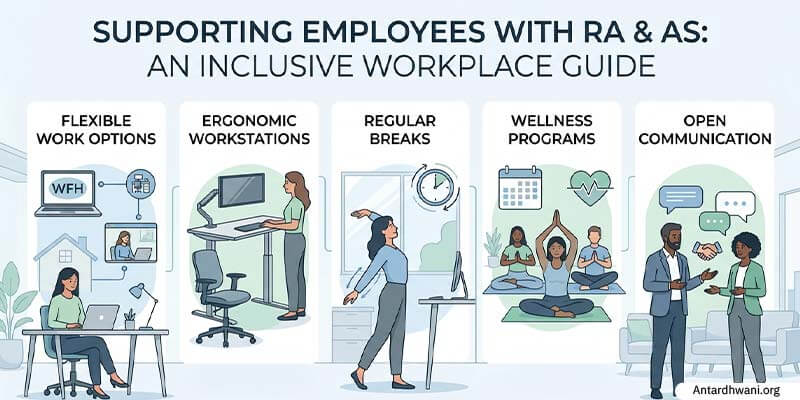
Morning stiffness is one of the most disabling symptoms of RA and AS. It peaks between 6am to 10am. Allowing a later start or working from home on difficult days can mean the difference between a productive day and a lost one.
Options to consider:
This is especially helpful for managing RA fatigue at work. It allows employees to work during their most productive hours rather than forcing them through their worst ones.
Sitting at a standard desk for 8 hours is hard on healthy joints. For someone with RA or AS, it can cause real damage.
Simple adjustments make a big difference:
These changes reduce physical stress and help employees work more comfortably throughout the day.
Staying in one position stiffens joints. Short breaks every 45–60 minutes allow employees to stretch, move, and return to work more comfortably.
This is not a loss of productivity. It is an investment in it.
Allowing brief stretch breaks without employees needing to explain themselves costs nothing and returns significant benefits.
Access to professional support helps employees manage their condition more effectively day to day:
These programmes help employees stay consistent in their work even on difficult days.
No support policy works if employees are too afraid to use it. Creating genuine psychological safety around health is essential.
Open communication means:
Encouraging open dialogue is not just good practice, it is how workplaces actually understand what support is needed.
Managers and HR professionals are the bridge between policy and real-world practice. A good policy written on paper means nothing if it is not implemented with understanding.
What good managers do
What HR teams should ensure
By fostering empathy and proactive support, organisations can create a workplace culture where employees with RA and AS feel valued. When they feel valued, they perform at their best.
Employers have both legal and ethical duties to support employees with chronic conditions.
In India, the Rights of Persons with Disabilities Act (RPWD Act, 2016) recognises certain chronic conditions. It places obligations on employers to provide reasonable accommodation.
Providing these accommodations does two things:
Beyond regulations, building an inclusive environment reflects the organisation’s values. It builds long-term trust, not just with employees who have chronic conditions, but with every person in the team.
Supporting employees with chronic conditions is not just the right thing to do. It directly improves business outcomes.
Employees who feel supported are more productive. They are more engaged and more committed to their roles. This matters especially in AS and RA situations, where the right adjustments can reduce absenteeism and improve long-term output.
| What organisations invest | What they gain |
| Flexible working options | Reduced absenteeism and staff turnover |
| Ergonomic equipment | Higher daily output and fewer discomfort-related complaints |
| Manager training | Stronger relationships and team trust |
| Wellness programmes | Lower presenteeism and better sustained performance |
| Inclusive culture | Stronger employer brand and improved recruitment |
Real-life adjustments show that small changes create meaningful results. The table below lists practical examples that directly address everyday challenges for employees with RA and AS.
| Adjustment | Challenge it solves | Cost to employer |
| Working from home 2 days a week | Removes a draining commute on stiff mornings | Zero |
| Sit-stand desk | Reduces pain from prolonged sitting | Low–medium |
| Flexible 10am start | Allows morning stiffness to ease before work begins | Zero |
| Ergonomic keyboard and mouse | Reduces wrist and hand strain during typing | Low |
| Closer parking bay | Eliminates a painful walk from distant car parks | Zero |
| Scheduled 5-minute breaks every hour | Prevents stiffening during long desk sessions | Zero |
| Occupational health review | Creates a personalised plan for each employee | Low |
| Private HR check-in every 3 months | Identifies issues before they become a crisis | Zero |
By implementing these strategies most of which are completely free organisations meaningfully improve employee comfort, efficiency, and job satisfaction.
Creating a workplace that supports employees with Rheumatoid Arthritis and Ankylosing Spondylitis is both a strategic and compassionate choice.
Awareness is growing and expectations are shifting. Organisations now have a real opportunity to build environments that are genuinely inclusive, not just in policy but also in practice.
Understanding how to support employees with RA and AS is key. It empowers people to manage their health without having to choose between their wellbeing and their career.
Organisations like Antardhwani play an important role in this work spreading awareness, offering guidance, and supporting individuals living with these conditions every day.
In today’s world, prioritising employee wellbeing is not just beneficial. It is essential.
Need guidance on living and working with RA or AS? Contact our team or explore our resources.


People with rheumatoid arthritis share goals and resilience. See why diagnosis in 12 weeks, access to treatment and peer support…

Discover why 70% of autoimmune disease patients are women. Learn the science behind AS, RA, lupus & more, plus diagnosis…

Living with AS or RA in India? This guide covers daily symptom management, real treatment costs, insurance gaps, mental health,…