

Imagine waking up every morning with stiff, aching joints, and you’re only 26.
That’s the reality for thousands of young Indians today. Conditions once considered “diseases of old age” are now showing up in people in their 20s and 30s. And the numbers are growing.
Autoimmune diseases, where the body’s immune system mistakenly attacks its own healthy cells, are becoming a quiet but serious public health crisis in India. If you’ve been experiencing unexplained fatigue, joint pain, or recurring inflammation, this blog is for you.
Your immune system is your body’s defense force. Its job is to fight off bacteria, viruses, and other harmful invaders.
But in autoimmune diseases, something goes wrong. The immune system can no longer tell the difference between your own healthy cells and foreign threats. So it starts attacking your own body, causing chronic inflammation, pain, and tissue damage.
There are over 80 known autoimmune diseases. The most common ones affecting young Indians include:
| Disease | What It Affects |
| Rheumatoid Arthritis (RA) | Joints, hands, wrists, knees |
| Ankylosing Spondylitis (AS) | Spine and sacroiliac joints |
| Lupus (SLE) | Skin, kidneys, joints, heart |
| Type 1 Diabetes | Pancreas (insulin-producing cells) |
| Psoriasis | Skin and sometimes joints |
| Thyroid disorders (Hashimoto’s, Graves’) | Thyroid gland |
These conditions are lifelong. They can’t always be cured, but they can be managed — especially when caught early.
India is seeing a sharp rise in autoimmune conditions, especially in urban populations.
Here’s what the data shows:
The full picture is still emerging; India-wide registry data on autoimmune diseases is limited. But the clinical trend is clear: these are no longer rare or age-restricted conditions.
One of the biggest problems with autoimmune diseases is that early symptoms are easy to dismiss. People assume it’s just stress, bad sleep, or aging. By the time they see a specialist, significant damage may already have occurred.
Watch out for these early signs:
Important: Having one or two of these symptoms doesn’t mean you have an autoimmune disease. But if you’ve had persistent or recurring symptoms for more than a few weeks, it’s worth consulting a rheumatologist.
India is witnessing a noticeable increase in autoimmune conditions, often described as part of a growing autoimmune epidemic in India.
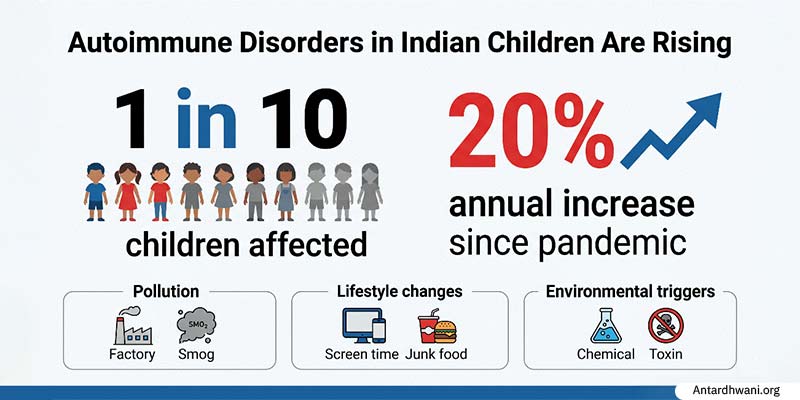
While comprehensive nationwide data is still evolving, multiple hospital-based studies and clinical observations suggest:
Young Indians are particularly vulnerable due to rapid lifestyle and environmental changes.
Autoimmune diseases have a genetic component — but genes alone don’t explain the recent surge. After all, our genes haven’t changed dramatically in 20 years. What has changed is our environment, our food, and our lifestyle.
The rise in young Indians is being driven by a combination of:
India’s urban population has grown by over 200 million in the last two decades. With cities come processed foods, pollution, sedentary jobs, and high-pressure environments, all known immune disruptors.
Interestingly, as sanitation improves and childhood infections decrease, the immune system may become “under-stimulated” early in life. Some researchers believe this makes the immune system more likely to turn against the body later on. This is one reason autoimmune diseases tend to be more common in more urbanized, developed environments.
Certain gene variants like HLA-B27, strongly associated with ankylosing spondylitis are more common in Indian populations. When combined with modern lifestyle triggers, the risk of disease activation increases significantly.
Traditional Indian diets, rich in whole grains, legumes, spices, and fresh vegetables, naturally support gut health and immune function.
Modern urban diets look very different:
A poorly functioning gut is now one of the most well-established risk factors for autoimmune conditions. Up to 70% of your immune system lives in your gut, so what you eat matters enormously.
India’s young workforce faces intense academic and professional pressure. Chronic stress keeps cortisol levels high, which over time disrupts the hormonal balance needed for healthy immune regulation.
Stress doesn’t cause autoimmune disease directly — but it is a well-documented trigger for flares and may accelerate disease onset in those who are genetically predisposed.
More desk jobs, more screen time, less movement. Regular physical activity helps regulate inflammation and immune response. Its absence does the opposite.
Late nights, screen exposure before bed, and irregular sleep schedules disrupt your circadian rhythm, the internal clock that regulates immune function, hormone release, and cell repair. Poor sleep is increasingly linked to chronic inflammatory conditions.
Cities like Delhi, Mumbai, and Ahmedabad regularly exceed safe air quality limits. Long-term exposure to particulate matter (PM2.5) and chemical pollutants has been linked to immune dysfunction and increased autoimmune risk.
Spending less time outdoors means less exposure to sunlight (vitamin D), diverse microbes, and natural immune-regulating environments. Vitamin D deficiency, very common in urban Indians, is associated with higher autoimmune risk.
In India, the average delay between first symptoms and correct diagnosis for conditions like ankylosing spondylitis can be 5 to 10 years. That’s years of unnecessary pain, disability progression, and psychological distress.
Why does this happen?
What can you do?
If you’ve had persistent or recurring symptoms (especially joint pain, morning stiffness, or fatigue), ask your GP for a referral to a rheumatologist, not just a general physician or orthopedic surgeon. Blood tests like ANA, RF, anti-CCP, ESR, CRP, and HLA-B27 can help identify autoimmune activity early.
Living with an autoimmune disease is more than just managing physical symptoms. It touches every part of life.
Physically, chronic pain and fatigue make everyday tasks commuting, working, cooking, exercising genuinely difficult. Flares can be unpredictable and disabling.
Emotionally, the uncertainty of a lifelong condition takes a toll. Many patients experience anxiety, depression, and grief over the life they had before diagnosis. This is entirely valid, and it deserves proper support.
Socially, autoimmune diseases can affect career progression, relationships, and social participation. Many young patients feel isolated or misunderstood, especially when their condition is “invisible” to others.
Financially, the cost of specialist consultations, medications (especially biologics), and regular tests can be substantial and is rarely covered adequately by standard insurance plans.
The good news? Early diagnosis and consistent management dramatically reduce these impacts. Many people with autoimmune conditions live full, active lives, especially when they have the right support.
You can’t change your genes, but you can significantly influence how those genes express themselves. Here’s what makes a real difference:
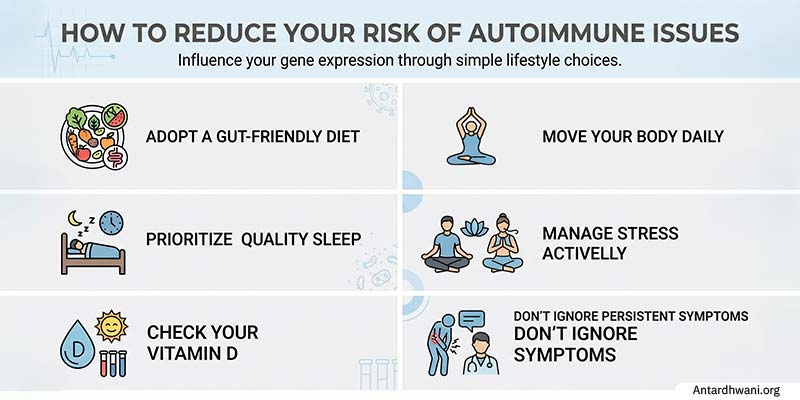
Eat a gut-friendly diet. Focus on whole, minimally processed foods. Include plenty of fiber (vegetables, legumes, and whole grains), fermented foods (curd, idli, and kanji), and anti-inflammatory spices like turmeric and ginger. Limit sugar, refined carbs, and ultra-processed foods.
Move your body every day. Even 30 minutes of moderate activity, like walking, yoga, or swimming, helps regulate the immune system and reduce chronic inflammation. You don’t need a gym.
Prioritize sleep. Aim for 7–9 hours of quality sleep. Keep a consistent sleep schedule. Limit screens for at least an hour before bed.
Manage stress actively: yoga, pranayama, meditation, journaling, or therapy. Pick what works for you. Stress management isn’t optional; it’s medical.
Get your vitamin D checked. Vitamin D deficiency is extremely common in India and strongly linked to autoimmune risk. Ask your doctor for a 25-OH vitamin D test. Spend time in morning sunlight.
Don’t ignore persistent symptoms. If something has been bothering you for weeks — especially joint pain, unexplained fatigue, or recurring inflammation — see a rheumatologist. Early detection changes outcomes.
As individuals, we can manage our own risk. But systemic change is needed to address this as a public health issue.
More rheumatologists are accessible to all. India has fewer than 1,000 rheumatologists for a population of 1.4 billion. Most are concentrated in metros. Rural and semi-urban populations have almost no access.
Autoimmune diseases in school and college health curricula Young people should know what these conditions are, what symptoms to watch for, and when to seek help. Basic awareness at the right age can prevent years of delayed diagnosis.
India-specific research We need large-scale epidemiological data on autoimmune disease prevalence, age of onset, and outcomes across Indian demographics, not just extrapolated from Western studies.
Insurance coverage for long-term treatment Biologics and disease-modifying drugs are expensive. Health insurance in India rarely covers the full cost of autoimmune disease management. Policy change is needed.
Workplace awareness Employers need to understand that autoimmune diseases are real, fluctuating, and sometimes disabling conditions, not excuses. Flexible work arrangements and mental health support matter.
Autoimmune diseases are rising among young Indians, and the reasons are woven into the fabric of modern life: what we eat, how we sleep, how much we move, how we manage stress, and the air we breathe.
The good news is that awareness, early action, and simple lifestyle changes can make a significant difference. This is not a condition you have to face alone.
At Antardhwani, we’re a community of people living with ankylosing spondylitis and rheumatoid arthritis, patients, caregivers, and advocates. We believe that no one should spend years in pain without a diagnosis. No one should feel alone in managing a condition that others can’t see.
If you or someone you know is experiencing persistent joint pain, fatigue, or stiffness, please don’t wait. Seek a rheumatologist’s opinion. Early care changes lives.


Discover why 70% of autoimmune disease patients are women. Learn the science behind AS, RA, lupus & more, plus diagnosis…

Living with AS or RA in India? This guide covers daily symptom management, real treatment costs, insurance gaps, mental health,…

Is ankylosing spondylitis really autoimmune? Unlike RA, it has no autoantibodies. Here's the real overlap - and why the difference…