
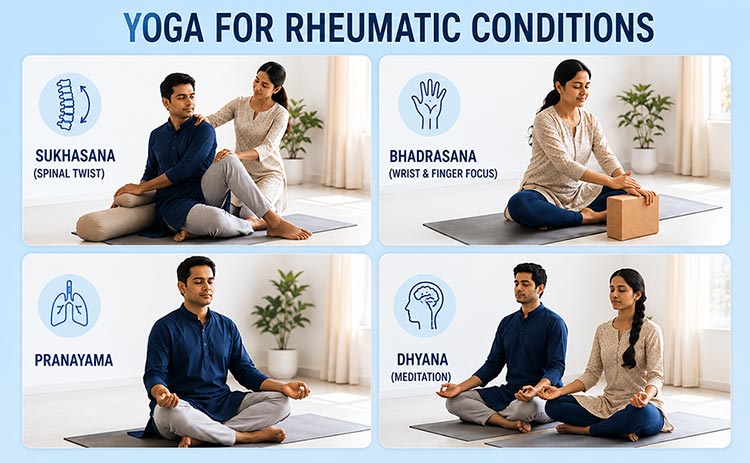
Inside the Antardhwani community, one story repeats often enough to notice. A member begins a gentle, regular yoga practice. Within a few weeks, morning stiffness loosens sooner. Movement comes back. And on the next blood report, inflammatory markers like ESR and C-reactive protein (CRP) often sit lower than they did before.
That is not a cure. It is a pattern, and it is worth understanding.
This International Yoga Day, on 21 June 2026, the message is personal. Your body is unique, so your yoga should be too. A spine fusing from ankylosing spondylitis does not need the same routine as a hand swollen from rheumatoid arthritis. A pregnant body, a desk-bound back, a student curved over a textbook — each one needs its own mat.
The need is real. The World Health Organization reported in June 2024 that nearly a third of adults worldwide, around 1.8 billion people, did not meet recommended activity levels in 2022. In South Asia, that figure climbs to 45%, the second highest of any world region. Most of us move too little, and our joints pay for it.
We will talk about body-specific starting points, grounded in research, for AS and RA bodies.
We personalize almost everything now. Treatment plans are matched to the patient. Trainers build programs around one person’s goals. Courses adapt to how each student learns. Even pizza and falafel are assembled one topping at a time. So why do we still have an entire room with the same yoga sequence?
Yoga works along a spectrum. At one end is generic yoga, the identical flow for everyone. In the middle is adapted yoga, where props and modifications meet a body where it is. At the other end is therapeutic yoga, a practice built around diagnosis and led by someone who understands it. For Ankylosing Spondylitis – AS and Rheumatoid Arthritis – RA, that end is where the real benefit sits.
Personalization begins with one rule. Get clearance from your rheumatologist, then work with a physiotherapist who knows your condition. A pose that frees one AS patient can strain another, depending on disease stage and which joints are involved. If you are starting out, our guides to the best exercises for ankylosing spondylitis and yoga and exercise for rheumatoid arthritis are the right first step.
Yoga is not a replacement for your medication. It works alongside it. Hold on to that distinction, because the evidence is built on it.
The work is close to home, too. A registered clinical trial recruited AS patients from Antardhwani’ s own membership in Ahmedabad to test a validated yoga module delivered remotely, with CRP and ESR among its outcome measures. Our members are not only practicing yoga. They are part of how it is being studied.
One honest limitation keeps this in perspective. Raised CRP or ESR shows up in only about 40 to 50% of AS patients, so bloodwork alone never tells the whole story. The most consistent gains from yoga are the ones you feel; loosens stiffness, easier movement, steadier sleep, and a calmer mind.
For AS, yoga has one job. Keep the spine and ribcage moving. AS drives inflammation through the sacroiliac joints and the spine. Over years, left unchecked, it can lay down syndesmophytes and fuse the vertebrae. The stooped, forward-bent posture that AS encourages is not your fate. Daily movement is counterweight.
A good AS routine works toward three things:
A few poses:
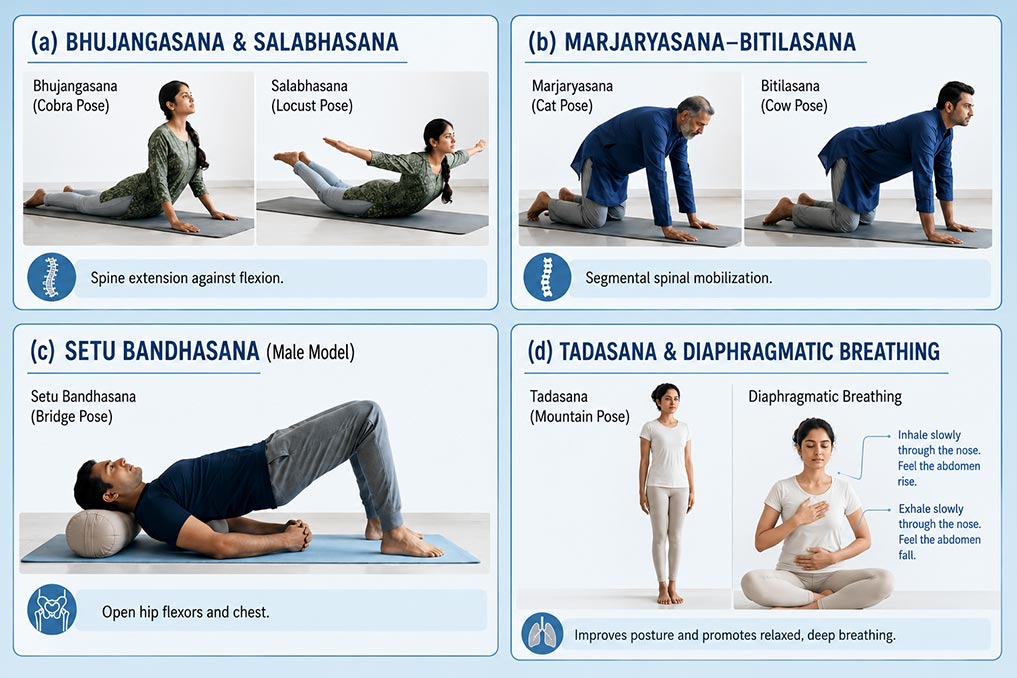
Frequency matters more than intensity. Aim for 15 to 20 minutes on most days, and warm up first. Little and often beats a hard session once a week. Avoid sustained deep forward folds and high-impact loading. On a flare day, shorten your range and stay with the breathing. Progress slowly, under guidance.
A senior member of our community, puts it plainly in his story with the right mindset and regular exercise, improvement is possible. For the clinical side, see what ankylosing spondylitis is, its early symptoms, and current treatment options.
For RA, the aim is range of motion and grip strength, without ever provoking a flare.
RA is systemic and symmetrical. It targets the synovium of small joints first, the fingers and wrists, before reaching larger ones. Yoga keeps those joints moving and the muscles around them strong, which protects function over the long run.
Three goals guide the practice. Maintain range of motion and cut down morning stiffness. Rebuild grip strength and balance, both of which improved in the trials above. And lower stress, a known flare trigger, while improving sleep.
Lead with the gentle, joint-sparing options:
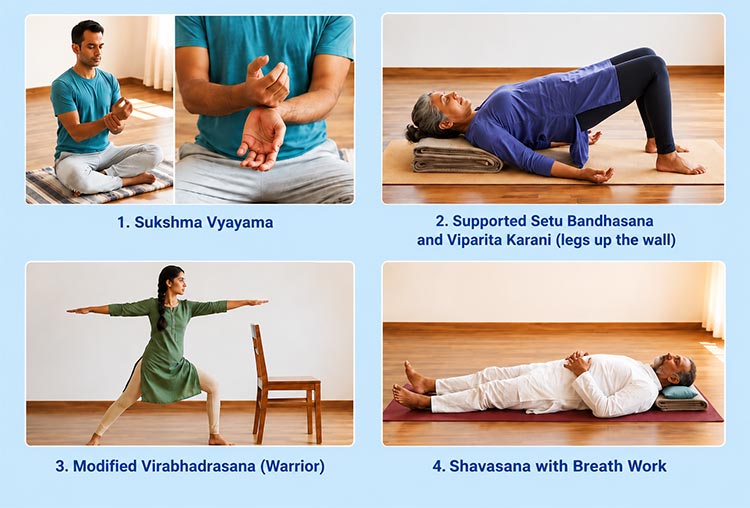
Flare days have their own rules. Rest the inflamed joint. Never weight-bear on one that is hot and swollen. Stay with breathing and gentle range-of-motion work until it calms. On steady days, 10 to 20 minutes is enough, and props — blocks, straps, and a chair — make almost any pose accessible.
One of our support group member lived seven years with RA before finding her footing. Her recovery story credits steady effort, expert advice, and the right support. If you want a full picture of managing the disease, read what rheumatoid arthritis is and how it is treated and managed.
One sequence was never going to serve everybody. AS and RA patients, desk workers, mothers-to-be, homemakers, students, and healthy adults each deserve a practice shaped to their needs.
You do not have to design it alone. Antardhwani connects patients with expert-led sessions, a network of more than 150 doctors on our panel, and a community that has walked the same path. We do not promise cures. We promise clarity, comfort, and company.
This Yoga Day, don’t ask your body to fit the yoga. Build the yoga around your body.


Autoimmune diseases are rising sharply among young Indians. Discover the key causes lifestyle changes, stress, diet, and pollution and learn…

Understand the role of physiotherapy in ankylosing spondylitis, including benefits, flare management, exercises, and whether it can reverse spinal fusion.

Is chronic illness affecting your work performance? Learn how the right support can help employees with rheumatoid arthritis and ankylosing…