

Rheumatoid arthritis (RA) is an autoimmune disease in which the immune system attacks the lining of the joints. It causes swelling, pain, and stiffness, often on both sides of the body and most often in the hands and feet.
If you have lived with RA for seven to ten years, you know this definition by heart, and you also know what it leaves out. It leaves the mornings you plan around stiffness, the doses you track on your phone, and the goals you have kept alive through all of it.
This article is about those goals. It covers what stands between people with RA and their plans. It also covers what must change, so the next patient has an easier path, and how a patient-led community works beside your rheumatologist.
Ask a person with RA about their dreams, and the answers are ordinary. They want to climb stairs without planning around them, cook a meal for the family, work a full day, hold a grandchild, or finish a train journey without a flare. These goals are specific and measurable, which is why researchers have started to ask patients about them directly.
Hetalben Bhavsar, a member of Antardhwani, our patient support group, describes what changed for her: “Seven years with rheumatoid arthritis showed me that steady effort, expert advice, and the right support can transform daily life.”
Pradip Tapania, who cared for his wife through the disease, says: “For four years, my wife battled rheumatoid arthritis. Through Antardhwani’s guidance and exercises, we found relief, confidence, and hope again.”
The courage in this setting is not dramatic. It means taking the disease-modifying drug on the day you feel well, keeping the appointment you could skip, and asking for help at work. None of this cure, and we do not suggest that it does, as our note on whether rheumatoid arthritis is curable explains. It keeps the disease controlled so that plans stay possible.
Long-term RA carries costs that grow quietly. A study at a North Indian tertiary hospital found that managing RA on conventional therapy costs an average of ₹51,741 a year. The same study found that RA pushed 14.92% of affected households into catastrophic health spending (Bali and Singla, Indian Journal of Rheumatology, 2024). If that cost stayed flat, seven to ten years of treatment adds up to roughly ₹3.6 to ₹5.2 lakh on conventional drugs alone, before any biologic.
Medicines drive most of that spending. A study from the Karnataka chapter of the Indian Rheumatology Association found that medication was the largest single cost for RA patients. It also linked delayed referrals to a rheumatologist with higher direct medical costs. In the North Indian study, work productivity was also impaired by close to 50% among patients with ankylosing spondylitis and RA.
RA rarely travels alone. In a multicentre Indian study, thyroid disorders appeared in 14.87% of RA patients over age 50 (Indian Journal of Rheumatology, 2025). Dr. Sapan Pandya, a senior rheumatologist on Antardhwani’s doctor panel, is among its co-authors. After years with RA, ask your rheumatologist whether a thyroid check is due; our doctor profiles can help you find one.
Fatigue adds to the load. A CreakyJoints and ArthritisPower poll found that 89% of people with arthritis said fatigue interfered with everyday activities. That figure covers arthritis in general, not RA alone, so read it as a pointer and not an RA-specific rate.
If you were diagnosed years ago, you may wonder whether a faster diagnosis would have changed your course. The evidence gives a careful answer. We recommend meeting a rheumatologist within 6 weeks of symptom onset and effective treatment started by the end of week 12.
A Indian qualitative study help explains why: people often put early symptoms down to diet, stress, or too much work before they seek help.
You cannot reopen that window for yourself, and the delay was rarely a personal failing. You can use it for someone else. A sister, a neighbor, or a colleague with joint swelling that lasts beyond six weeks should see a rheumatologist and not wait. Our pages on the causes and treatment of rheumatoid arthritis give you words to start that conversation.
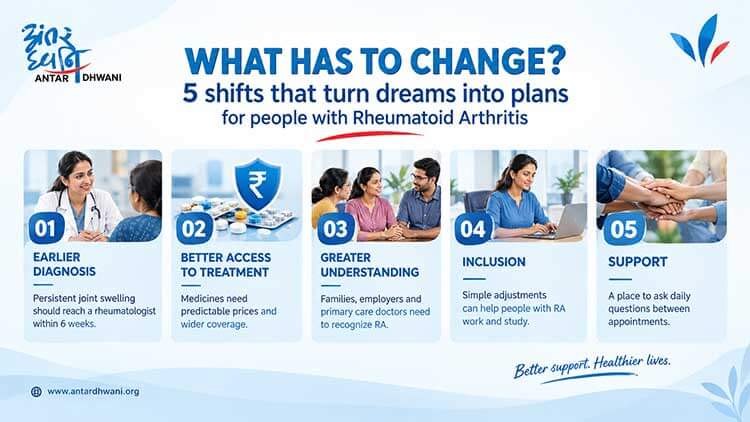
Dreams need more than willpower. Five changes would put them within reach for people with RA, and the first three build directly on the studies cited above.
After years of treatment, many patients ask what a support group still adds. Our answer is that it sits beside your rheumatologist and never replaces one. Medicines and monitoring control the disease, and a patient support group helps you stay with that care and handle what happens between appointments.
In a 2025 randomized trial in Scientific Reports:
Evidence for pain and fatigue is mixed, according to a 2023 review in Patient Preference and Adherence, and we make no promise of fewer flares. For long-term patients, peer support also runs in both directions. You have seen drug changes, flares, and setbacks, and a newly diagnosed member has not.
A group also helps you prepare for review of visits. List your questions in advance: how your disease activity is measured, whether a thyroid check is due, and what lower-cost options exist. Your rheumatologist makes the medical decision, and you arrive better prepared to make it together.
Antardhwani runs doctor-led patient sessions in cities like Ahmedabad in Gujarat and Jaipur in Rajasthan, India. Topics include accepting and managing RA and AS, and hormones, fertility, and inflammation in women.
Have a question for a rheumatologist?
Ask the Expert »World Arthritis Day falls on Monday, 12 October 2026, and we want to help you all to “Achieve Your Dreams”. We want you all to work towards your goals and hopes. For all those out there suffering from rheumatic and musculoskeletal diseases, we want you to work on your strengths, and on earlier diagnosis and more effective, personalized treatment. This article puts that theme to work for people with RA in India.
Three steps for this week:
The clinic treats the joints, and the patient support group helps protect the dream. After seven or ten years the dream has changed shape, but it is still yours. Push for earlier diagnosis for the next patient, push for treatment that stays within reach, and do not carry RA alone.
Living with RA, caring for someone who is, or still waiting for answers? Become an Antardhwani member and join a patient-led community that treats you than your disease.
Join Us »

Discover why 70% of autoimmune disease patients are women. Learn the science behind AS, RA, lupus & more, plus diagnosis…

Living with AS or RA in India? This guide covers daily symptom management, real treatment costs, insurance gaps, mental health,…

Is ankylosing spondylitis really autoimmune? Unlike RA, it has no autoantibodies. Here's the real overlap - and why the difference…