

Will I be able to live a normal life? This question arises before almost any other, once a patient is diagnosed with ankylosing spondylitis or rheumatoid arthritis. For most patients, the honest answer is yes, with consistent management and the right support around you. This guide covers what that actually takes in India: daily symptom management, the real cost picture, the mental health side rarely discussed openly, and how work and relationships fit into a life that includes AS or RA without being defined by it.
Normal doesn’t mean unchanged. It means managed well enough that the disease stops running the show. That distinction matters, and this guide walks through exactly how patients across India get there.
Every section in this patient’s guide draws on India-specific, peer-reviewed data rather than general international figures, because the cost, insurance, and specialist-access picture in India looks meaningfully different from what patients face elsewhere. Where a claim touches your specific treatment, insurance, or family planning decisions, treat it as a starting point for a conversation with your rheumatologist, not a replacement for one.
Living normally with a chronic autoimmune condition rarely means symptom-free forever. It means reaching a stage that rheumatologists call for remission. It is a situation with long stretches of low or no disease activity, achieved through consistent medication, physical therapy, and movement. Remission is genuinely achievable for most patients, particularly with early treatment. However, it requires ongoing management rather than a one-time fix.
As an individual suffering from RA or AS, you are not managing something rare or unusual. According to Indian Journal of Rheumatology, AS affects an estimated 0.03% of India’s population, based on pooled survey data, while the broader spondyloarthritis family of conditions affects roughly 7 to 9 per 10,000 people. This means there are hundreds of thousands of people across the country with similar doubts and questions that you are having right now.
What remission actually looks like depends on person to person.
You cannot expect an identical outcome for every patient. Instead, it’s finding your own stable baseline and building a routine that protects it. Tracking your own pattern, rather than comparing your progress to someone else’s timeline, will give you more accurate and less discouraging picture of how treatment works.
Here we recommend four habits to help you the most in keeping your AS and RA symptoms manageable day to day:
Medication adherence comes first, since skipping doses to save money or out of convenience raises the risk of a flare that costs far more later, both physically and financially.
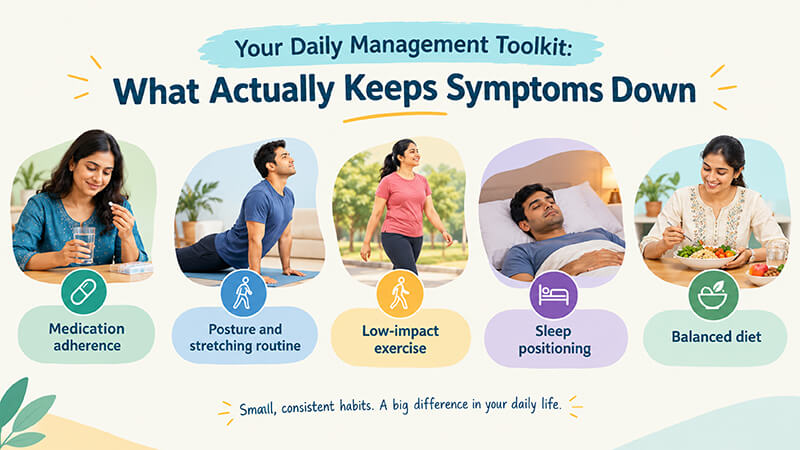
Be cautious of any diet or supplement claiming to replace your prescribed treatment entirely and raise dietary changes with your doctor rather than adopting them on advice from unverified sources. Social media wellness trends move faster than clinical evidence, and a claim of popularity online says nothing about whether it’s safe for your specific treatment plan. None of this replaces your treatment plan; it supports it. Raise each of these habits directly with your rheumatologist rather than adjust your regimen on your own.
A lot of patients are worried about the cost involved in the treatment rather than the disease itself. We strongly feel that this concern deserves a straight answer.
Medicines:
That gap between conventional and biologic costs is worth understanding early, since many patients eventually need biologics once conventional drugs stop controlling disease activity on their own.
Insurance:
Though the numbers are real, they don’t tell the whole story. Here are some things worth knowing about the costs:
Planning with your rheumatologist, rather than discovering costs of mid-treatment, changes how manageable this burden feels in practice.
Plan your treatment with a rheumatologist. »Chronic pain conditions carry well-documented, elevated rates of anxiety and low mood, and financial or work-related stress about the condition compounds this rather than sitting separately from it. Patients often describe this as a second, parallel weight: the disease itself, and the ongoing effort of managing life around it.
The flare tends to show up in specific moments rather than as one constant feeling:
Naming these moments as part of managing the disease, not as separate personal struggles, will make it easier for you to talk about, both with a therapist and with the people closest to you. This experience is common, not a personal failing, and it deserves the same attention as your physical symptoms.
Rheumatologists on the panel of Antardhwani, who lead the doctor-patient sessions featured on our YouTube channel, consistently point out that patients who address the emotional weight of a chronic diagnosis alongside physical treatment tend to stay more consistent with their medication and daily management overall.
If research is to be believed, average work-productivity impairment among AS and RA patients reaches close to 50%, irrespective of previous or existing employment status. It also means that most patients continue full careers with AS or RA, particularly with early treatment. Flare-related absenteeism and reduced productivity are real, which is why it is important to plan things in advance, not hiding it, making proactive planning more useful than reactive damage control.
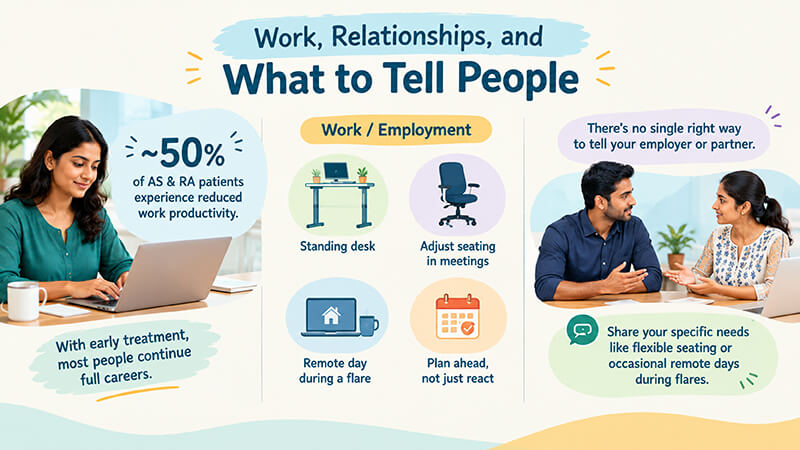
Work/Employment:
So, in a way we are talking about
There is no single right way to tell an employer or partner about your diagnosis. Naming specific needs, such as flexible seating or occasional remote days during flares, tend to land better than a vague announcement of illness.
Marriage and parenthood:
Marriage and parenthood remain fully possible for most AS and RA patients, and specific questions about family planning are best raised directly with your rheumatologist rather than answered generically here.
Timing disclosure often matters as much as wording. Many patients wait until a flare directly affects their work before saying anything, which can read as sudden or alarming to colleagues who have no context beforehand. Mentioning the condition early, in plain and matter-of-fact terms, generally builds more understanding than explaining it reactively during a difficult week.
Patients who connect with other patients managing the same condition report better day-to-day coping. They also have practical knowledge like which foods trigger flares or which employers have been accommodating, spread faster through community than through a single doctor’s visit.
This matters more in India specifically as less than 1,000 practicing rheumatologists serve a population of 1.4 billion, which means much of the support between appointments falls to community and self-management.
That specialist shortage also means appointment gaps of several months are common in many cities, particularly outside major metros. A community of other patients doesn’t replace that specialist relationship, but it fills the space between visits with practical, lived experience: what a new medication side effect actually feels like, how someone else navigated a difficult employer conversation, or simply confirmation that a bad week doesn’t mean treatment has failed.
To read more about autoimmune diseases rising in young Indian.
Read this blog »Will your life still be normal? Normal doesn’t mean unchanged. It means managed, supported, and still, yours to build, with the right medical care and the right people around you. Every step in this guide, from daily habits to community support, exists to make that version of normal genuinely achievable. The path looks different for every patient, but the destination, a life that includes AS or RA without being ruled by it, is reachable for most people who commit to consistent care.


Is ankylosing spondylitis really autoimmune? Unlike RA, it has no autoantibodies. Here's the real overlap - and why the difference…

Autoimmune diseases are rising sharply among young Indians. Discover the key causes lifestyle changes, stress, diet, and pollution and learn…

Whether rheumatoid arthritis can be cured permanently. Learn about treatment options, remission, lifestyle changes, and early diagnosis for better outcomes.