
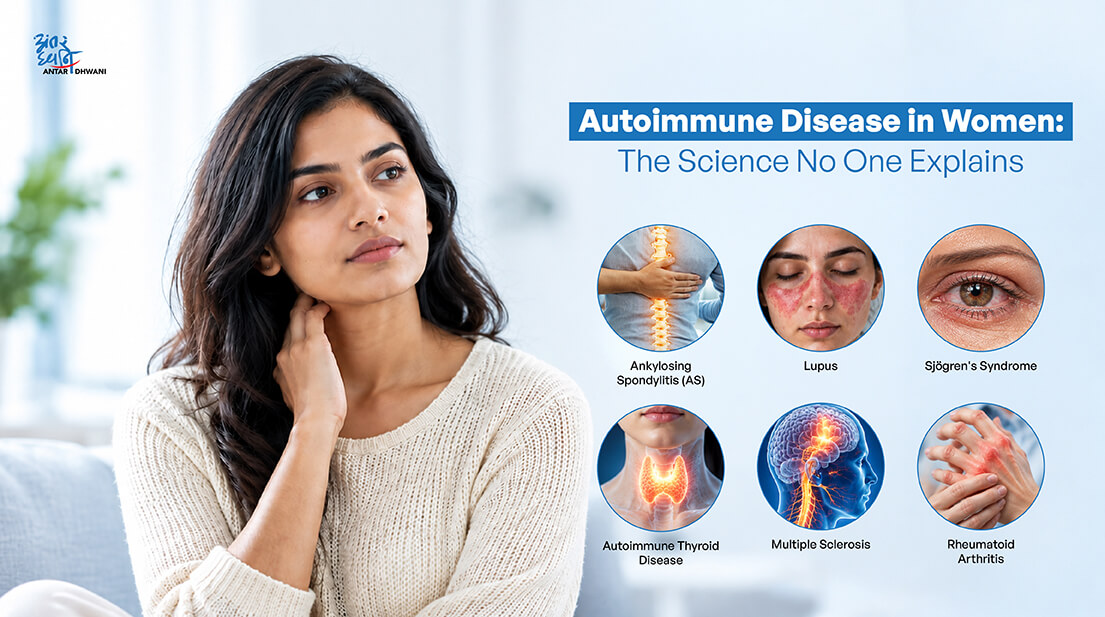
An autoimmune disease is a condition where your immune system mistakenly attacks healthy cells, tissues, and organs in your body instead of fighting off outside germs. Geeta, the 25-year athlete, never knew that such a disease existed and she could be affected by it. The first symptoms arrived quietly in early 2016. Her hair started thinning in the shower drain. She gained eight kilos in four months without changing her diet. Cold weather left her fingers numb long after everyone else warmed up.
Her doctor initially blamed stress and prescribed rest. A blood test finally found the real cause: her thyroid-stimulating hormone was far outside the normal range. She was diagnosed with Hashimoto’s thyroiditis, an autoimmune disease in which the immune system slowly attacks the thyroid gland.
Three years of medication kept her thyroid levels steady, until a new problem emerged. Her fingers began swelling every morning, stiff and difficult to bend until well past breakfast. Her rheumatologist immediately recognized the pattern; symmetrical joint swelling, worse after rest, easing slightly through the day. The diagnosis was rheumatoid arthritis, a separate autoimmune disease that had arrived on top of the first one. Her doctor wasn’t surprised as thyroid disorders show up in nearly 15% of Indian RA patients over 50, she explained, and gender itself raises that risk further.
Geeta’s diagnostic journey didn’t end there. A mouth ulcer that wouldn’t heal, a faint rash across her cheeks after a beach holiday, and unexplained joint pain in her knees sent her back to the same rheumatologist two years later. Blood work showed several overlapping antibodies, not a clean match for any single disease. Her doctor described it as an undifferentiated connective tissue disorder, sharing features with lupus without meeting every criterion for it. “You don’t always fit one box,” she told Geeta. “Sometimes the immune system writes its own rules.”
Geeta’s story isn’t unusual among the women around her. Her college roommate Meera spent six years being told her lower back pain was poor posture, before a rheumatologist finally diagnosed ankylosing spondylitis. Geeta’s aunt, who had spent a year blaming blurred vision and a tingling leg on stress and age, was eventually diagnosed with multiple sclerosis after an MRI found lesions on her spinal cord. Three women, one extended family, five different autoimmune diagnoses between them, and every one of them female.
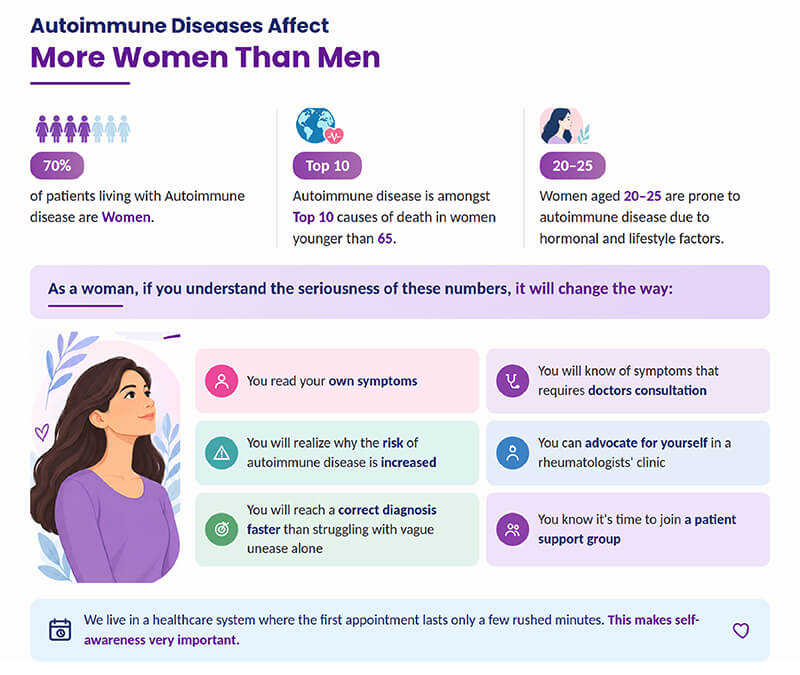
70% of people living with autoimmune diseases are women, and it needs to be recognized as a major health issue in India. To the extent that autoimmune diseases are now among the top 10 causes of death worldwide in women younger than 65, is what Indian Rheumatology Association (IRACON 2025) suggests.
Understanding why starts with the biology behind these numbers.
Here we have tried to cover six autoimmune conditions that disproportionately affect Indian women. It includes ankylosing spondylitis, rheumatoid arthritis, lupus, autoimmune thyroid disease, Sjögren’s syndrome, and multiple sclerosis. Each looks different in the body, yet all six share a common biological reason for targeting women more often.
If you want the fuller science behind how autoimmune disease is classified in the first place, our earlier guide on autoimmune disease Vs ankylosing spondylitis covers that ground in detail. This article focuses specifically on the sex gap: why it exists, how large it actually is, and what it means for managing your health going forward.
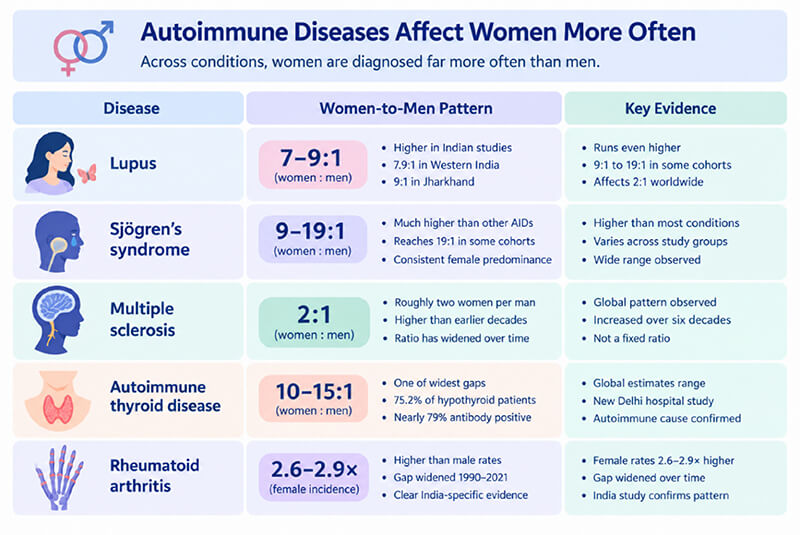
Roughly four out of five autoimmune disease patients are female, but that aggregate number hides enormous variation between conditions. Breaking down the ratio of condition by condition shows how uneven this risk actually is.
Reading these comparison ratios together tells a more complete story than any single number does.
Increase in antibody production leads to lupus and Sjögren’s, and it consists mostly of females. Conditions with a stronger T-cell or genetic component, like AS, show a smaller though still meaningful gap. That distinction is not just academic; it hints why the biological mechanisms covered in the next section affect different conditions to different degrees.
Saina Nehwal’s story highlights an important conversation around arthritis, injury prevention, and timely care. The badminton champion has spoken about her knee arthritis and how better access to physiotherapy, sports science, specialist care and mental conditioning may have helped her manage injuries differently.
Her experience is a reminder of the importance of early awareness, timely diagnosis, and the right support for joint health.
Read the full story: Saina Nehwal’s experience with arthritis and what we can learn from it
The explanation starts with “chromosome” we last studied in school biology. Women carry two X chromosomes, and one is normally silenced. A molecule called Xist manages that silencing process. A study found out that Xist can trigger harmful antibody responses. Blood samples from three autoimmune conditions, mostly affecting women, showed higher antibody levels against Xist-related proteins than healthy donors.
Estrogen increases activity in T cells and B cells. It is the immune system’s main defenders, and its boost helps women fight infections more effectively. But it can also intensify misdirected immune responses in people already prone to autoimmune disease.
None of these makes a woman’s immune system weaker. It makes the system more active, doing extra work during pregnancy and menstruation. Researchers are now studying Xist as a target for future, more precise treatments. Genetics and environment build on this baseline. The same genes get activated more easily in women. This is why sisters with identical family history can still have very different outcomes.
These six conditions may look different, but recognizing their basic patterns early shortens the path to a correct diagnosis from months to years.
Lupus (Systemic Lupus Erythematosus)
Autoimmune Thyroid Disease (Hashimoto’s and Graves’)
Sjögren’s Syndrome
Multiple Sclerosis (MS)
AS diagnosis alone can take up to a decade from first symptom to confirmed diagnosis. That delay is frequently longer for women specifically, since early symptoms are more often initially attributed to stress, anxiety, or normal hormonal change before a physical cause is investigated at all.
One striking data point makes this pattern concrete. A peer-reviewed cohort study found that women with postpartum depression had a significantly higher risk of a later autoimmune diagnosis, including rheumatoid arthritis, compared to women without postpartum depression.
That finding suggests some early autoimmune symptoms may be misread as a mental health issue rather than investigated physically. It delays the diagnosis. So, in such cases, women should:
All these, along with physical terms, help to move a diagnosis forward faster than describing it in the general language of exhaustion or stress. It gives a doctor something concrete to work from the very first appointment, rather than a vague description reconstructed from memory under time pressure.
Puberty, pregnancy, and menopause each shift autoimmune risk in different, sometimes opposite directions, depending on the condition. A comprehensive review in Frontiers in Endocrinology (2019) found that lupus incidence peaks in the 40 to 49 age group among women, coinciding with perimenopause, while RA risk rises specifically with earlier-than-average menopause.
Pregnancy affects each condition differently rather than following one universal pattern:
This is precisely why timing matters. Women planning a pregnancy with an existing autoimmune diagnosis benefit from raising that plan with a rheumatologist well before conception, not after a pregnancy is already underway, since some medications need adjustment ahead of time.
Puberty carries its own risk shift, one that is easy to overlook since it arrives well before most autoimmune diagnoses. Earlier age at menarche is associated with increased RA risk later in life, while later menarche is linked to reduced MS risk, suggesting the hormonal changes of adolescence lay groundwork that surfaces only years afterward. This is not a reason for alarm during a daughter’s teenage years, but it is reason family history conversations are worth having early rather than only after symptoms appear.
Autoimmune conditions rarely arrive alone, particularly as patient’s age. An Indian study of RA patients found that thyroid disorders appeared in 14.87% of patients over age 50, closely matching prior Indian research on the same overlap, and found that gender significantly influenced thyroid disorder risk within the RA population itself.
This study carries a direct connection to Antardhwani’s own network. Dr. Sapan Pandya, a senior rheumatology consultant on Antardhwani’s doctor panel, is among its co-authors. Beyond this research, Dr. Pandya has personally guided people in patient support group meetings in Ahmedabad and Vadodara. The aim was to connect patients living with one of the most female-predominant autoimmune conditions directly to specialist knowledge and to each other.
If you manage RA, ask your rheumatologist about a routine thyroid panel, particularly once you pass age 50. If you manage lupus or Sjögren’s, ask about screening for related conditions rather than waiting for a second diagnosis to surface on its own.
Overlap risk runs in both directions. A patient diagnosed with autoimmune thyroid disease has a measurably higher chance of later developing a second autoimmune condition than someone without one, since the same underlying genetic and immune tendencies that produced the first diagnosis remain active afterward. Treat one diagnosis as a reason for broader vigilance, not as a single, isolated event that concludes once treatment begins.
Meet the rheumatologist behind this researchAcross all six conditions, three habits consistently separate patients who maintain a stable, manageable life from those who don’t:
None of this requires reinventing your routine from scratch. Our existing guide walks through daily management, the real cost of treatment in India, and the mental health side of a chronic diagnosis in far more depth than this article has room for.
Work and family planning deserve the same proactive approach as medication. Naming specific needs at work, flexible seating, occasional remote days during a flare, tends to land better with employers than a vague announcement of illness after the fact. The same principle applies to family planning conversations with a rheumatologist: raised early, they shape a safer plan; raised late, they force reactive decisions under pressure.
Want personalized guidance on managing your specific condition?
Request a consultation »Symptom dismissal is a shared experience across all six conditions covered here, not a personal failing unique to any one patient. That shared experience is exactly why joining Antardhwani, the patient support group matters as much as clinical care. It is very helpful for conditions where diagnosis often takes longer, and symptoms are harder to explain to people outside the condition.
Antardhwani’s own patient stories, featured on our YouTube channel, follow the same principle, giving women a place to hear how others pushed for their own diagnosis and built a stable life afterward.
Community support closes a gap that a single clinic visit cannot. A rheumatologist sees a patient for minutes every few months; other women managing the same condition are available for the questions that come up in between, the side effect that feels alarming at 11pm, the flare that hits during a family wedding, the everyday problem-solving that clinical literature rarely addresses directly.
Four out of five autoimmune disease patients are women, and the science behind that number is finally catching up to what patients have described for years. That science does not mean women should carry the burden of self-advocacy alone. It means the pattern has a name, a growing body of research behind it, and a community, both clinical and peer-to-peer, ready to meet you at whichever stage of diagnosis or management you’re in right now.
Whether you are years into managing a diagnosis or still gathering words to describe what you’re feeling to a doctor for the first time, that community and that research exist for exactly this moment.


Living with AS or RA in India? This guide covers daily symptom management, real treatment costs, insurance gaps, mental health,…

Is ankylosing spondylitis really autoimmune? Unlike RA, it has no autoantibodies. Here's the real overlap - and why the difference…

Yoga isn't one-size-fits-all. Discover safe, condition-specific yoga poses and routines for ankylosing spondylitis and rheumatoid arthritis, backed by research.